Wondering if a Punta Gorda gulf-access home will actually work for your boat? That is the question that matters most, because a beautiful canal-front property can still be the wrong fit if the route, dock setup, or bridge clearance does not line up with how you boat. If you are buying with a lift, slip, or easy run to open water in mind, this guide will help you evaluate the details that count before you commit. Let’s dive in.
Start With the Route
In Punta Gorda, gulf access is not just about having water behind the house. It is about whether your boat can travel from that dock to open water comfortably and legally.
NOAA notes that Charlotte Harbor’s federal project channel is 32 feet deep from deep water in the Gulf to Port Boca Grande. The same Coast Pilot text reports a controlling depth of 9 feet in the natural channel from Port Boca Grande through Charlotte Harbor to the mouth of the Peace River, and it notes small-craft anchorage depths of 7 to 11 feet in parts of the harbor. That means access can vary based on the exact route you plan to run.
For buyers, the takeaway is simple: evaluate the full path, not just the backyard seawall. A property may look ideal on a listing sheet, but the canal, turning basin, harbor route, and final approach to the Gulf all need to fit your boat’s dimensions and your boating style.
Match Your Boat to the Waterway
Before you get too far into a search, compare your boat’s loaded draft, beam, and air draft to the property and the route to open water. This is the practical test that tells you whether the home, dock, canal, and travel corridor work together.
Draft matters because a deeper boat may limit your options in shallower canals or along certain routes. Beam matters because dock layout, canal width, and maneuvering room all affect how comfortably you can get in and out. Air draft matters because bridge clearances can quickly rule out an otherwise attractive property.
Check Peace River Bridge Clearances
If your route uses the Peace River, pay close attention to fixed bridges. NOAA’s Coast Pilot states that U.S. Route 41 at Punta Gorda has two fixed spans with 45-foot clearance, and Interstate 75 also crosses the Peace River with fixed bridges at 45 feet.
If your vessel approaches those numbers, do not assume it will be fine. Measure carefully and verify the exact route before you make an offer.
Factor In Current and Travel Time
A quick glance at a map can make a property seem close to open water. Real-world boating time can tell a different story.
NOAA says vessels should approach Charlotte Harbor through the Charlotte Harbor Safety Fairway. It also reports that tidal currents in the entrance channel average 2.2 knots at strength, while Peace River current is about 0.4 knot at strength. Those conditions can affect how long it takes to get where you want to go.
Understand Punta Gorda Speed Rules
Travel time in Punta Gorda is also shaped by local speed regulations. The City of Punta Gorda says all canals within the Burnt Store Isles and Punta Gorda Isles canal maintenance districts are Slow Speed Minimum Wake zones.
The city also applies similar slow-speed treatment to other shorelines waterward to the six-foot depth contour in city code. In plain terms, a short distance may still mean a slower run than you expect. If your ideal boating day includes frequent Gulf trips, this is worth weighing early.
Evaluate the Dock and Lot Geometry
For many waterfront buyers, the deciding factor is not the house itself. It is whether the lot can support the dock, lift, and access setup you want.
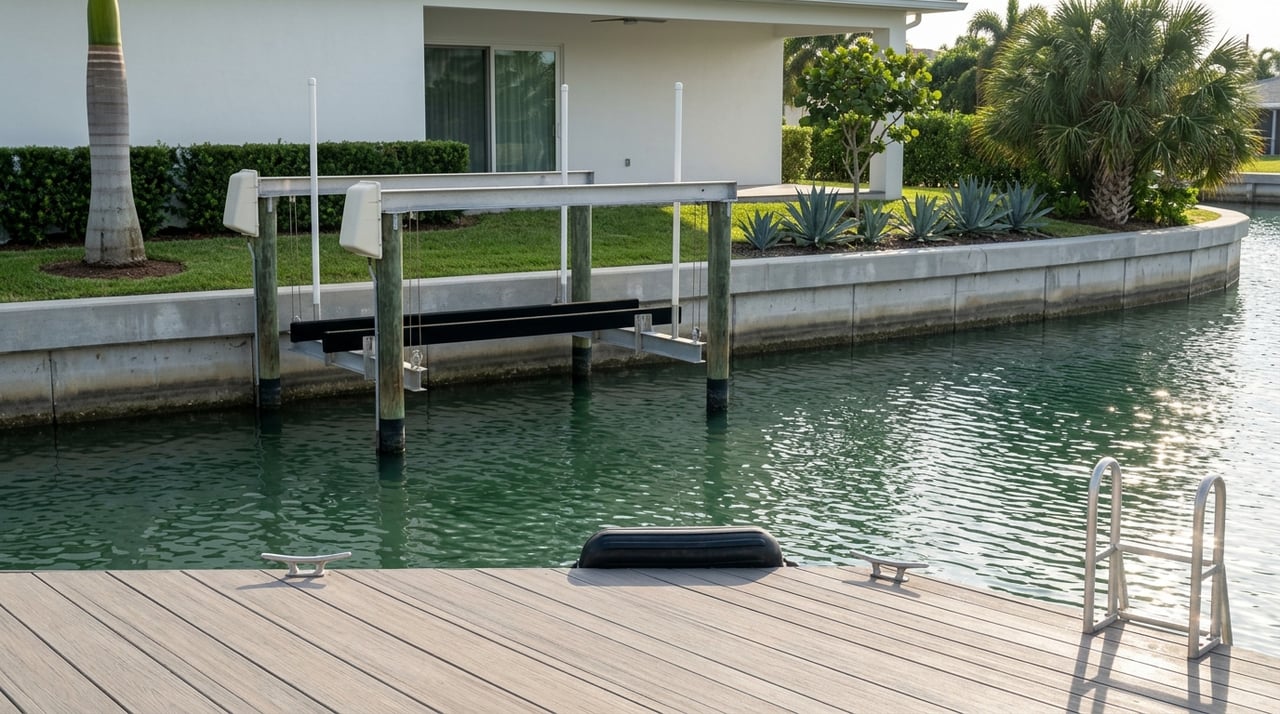
Punta Gorda’s waterfront rules are highly geometry-dependent. On single-family lots with less than 85 feet of seawall, the city generally allows a freestanding dock that protrudes no more than 10 feet waterward from the seawall, plus either one boat lift or up to three mooring piles. Lots with 85 feet or more of seawall may allow additional configurations.
That means frontage matters. So do structure limitation lines, because usable space over the water is not simply a matter of lot size.
Why Seawall Length Matters
A wider lot often gives you more flexibility for lift placement, mooring, and maneuvering. A narrower lot can still work well, but only if the allowed dock footprint aligns with your boat and your intended use.
If you plan to keep a larger vessel behind the home, review seawall length and canal width early in the process. Those two details can save you from falling in love with a property that cannot support the boating setup you want.
Deeper-Draft Boats Need Extra Care
On certain waterfront frontages, Punta Gorda allows docks on Charlotte Harbor or the Peace River to extend far enough to reach 3 feet of water at Mean Lower Low Water, but never more than 80 feet from the seawall or mean high-water line.
This rule can be important if your boat needs more water than a shallow canal dock provides. Even then, you still need to confirm that the allowed extension, water depth, and permit path all line up.
Check Seawall, Dredging, and Maintenance Exposure
Owning a gulf-access property also means understanding the maintenance side of waterfront living. The City of Punta Gorda maintains 45 miles of canals and inlets and 91 miles of seawalls, and it funds canal maintenance through canal maintenance district assessments.
For buyers, that means canal maintenance status and assessment exposure should be part of your due diligence. These are not minor background details. They are part of the ownership picture.
The city also says property owners may contract, at their own expense, for dockside maintenance dredging under the city’s existing state and federal permits. If a property needs dredging or seawall work, that can affect both cost and timeline.
Review Mangroves and Waterfront Conditions
Mangroves can affect visibility, maneuvering, and ongoing maintenance along canal-front property. In Punta Gorda, canal-side mangroves are regulated.
The city says licensed trimmers are required for mangroves taller than 10 feet. No more than 25 percent of foliage may be trimmed in a year, mangroves cannot be cut below 6 feet, and herbicides are prohibited. If mangroves are present, treat them as part of the boating-access conversation, not just as landscaping.
Verify the Permit Path Before Closing
One of the most common mistakes buyers make is assuming that a future dock, lift, canopy, or dredging plan will be easy to approve. In Punta Gorda and Charlotte County, that assumption can lead to expensive surprises.
Whether the property is inside the City of Punta Gorda or in unincorporated Charlotte County matters because the permit path can differ. Charlotte County’s residential dock permit process may require plans, site information, zoning and right-of-way review, and outside approvals from the Florida Department of Environmental Protection and or the U.S. Army Corps of Engineers.
In other words, a dock concept that looks possible on paper still needs permit verification. If a feature is important to your boating lifestyle, confirm it before closing, not after.
Do Not Skip HOA and Community Rules
If the property is governed by an HOA or another association, review the documents before you assume your boating setup will be allowed. Florida law requires homeowners’ associations to keep declarations, bylaws, and current rules as official records.
For a gulf-access buyer, those documents are where you may find restrictions on docks, lifts, canopies, boat storage, rentals, or architectural approval. Florida law also says that if an improvement request is denied, the association must identify the specific rule or covenant it relied on.
That makes written review especially important. City or county code approval does not automatically mean an association will allow the same improvement.
Account for Manatee Zones
In and around Punta Gorda, boating routes may also be affected by manatee protection zones. FWC’s Charlotte Harbor boating-zone information shows designated manatee protection zones around Punta Gorda, Port Charlotte, and the Peace River.
These zones can affect where slow operation is required and how long your route may take in practice. If your goal is quick and easy day cruising, include these zones in your route review from the start.
A Practical Punta Gorda Checklist
Before you move forward on a gulf-access property, use this checklist:
- Confirm your boat’s loaded draft, beam, and air draft.
- Map the exact route from dock to open water.
- Check bridge clearances if the route uses the Peace River.
- Review canal width, seawall length, and dock footprint potential.
- Verify structure limitation lines and lift placement options.
- Ask about permit history, dredging needs, and seawall condition.
- Review canal maintenance district assessments where applicable.
- Confirm whether the property is in the City of Punta Gorda or unincorporated Charlotte County.
- Read HOA or association rules before assuming any dock or lift changes will be approved.
- Check slow-speed areas and manatee zones that may affect travel time.
Why Local Waterfront Guidance Matters
On paper, two gulf-access homes can sound very similar. In reality, one may suit your boat beautifully while the other creates daily compromises around depth, clearance, dock layout, or run time.
That is why waterfront buying in Punta Gorda requires more than a standard home search. You need a property-level review that connects the lot, the code, the route, and your boating goals into one clear decision.
If you are exploring gulf-access homes and want help narrowing down which properties truly fit your boat and lifestyle, Waterfront Lifestyle Group can help you evaluate the details that matter most.
FAQs
How do you evaluate gulf-access property in Punta Gorda for a specific boat?
- Start by matching your boat’s loaded draft, beam, and air draft to the exact route, dock area, canal geometry, and any bridge clearances between the property and open water.
What bridge clearances matter for Peace River boat access in Punta Gorda?
- NOAA’s Coast Pilot states that both U.S. Route 41 and Interstate 75 cross the Peace River with fixed bridge clearances of 45 feet, so buyers should verify air draft carefully if their route uses that corridor.
What dock rules affect waterfront lots in Punta Gorda?
- Punta Gorda’s code ties dock and lift options to details like seawall length, waterward projection limits, and structure limitation lines, so frontage and lot geometry can directly affect what is allowed.
What ownership costs should buyers check for Punta Gorda canal-front homes?
- Buyers should review canal maintenance district assessments, possible dredging needs, seawall responsibility, and any permit-related costs tied to dock or waterfront improvements.
What community rules should buyers review for Punta Gorda gulf-access homes?
- If a property is in an HOA or association, buyers should review the declaration, bylaws, and current rules for restrictions related to docks, lifts, canopies, boat storage, and approval requirements.
What local boating rules can affect travel time from a Punta Gorda waterfront home?
- Slow Speed Minimum Wake rules in city canals, additional shoreline slow-speed areas, and manatee protection zones around Punta Gorda and the Peace River can all make actual travel time longer than map distance suggests.